

How to Register Copyright in Canada: 2026 Step-by-Step CIPO Guide
To register a copyright in Canada, file an application with the Canadian Intellectual Property Office (CIPO) under the Copyright Act. CIPO typically issues a Certificate of Registration within 4–8 weeks. Registration is not mandatory — copyright exists automatically the moment an original work is fixed in tangible form — but registration provides a public record and is admissible as evidence in court.
This guide covers:
- Who can register and what works qualify
- The 6-step CIPO filing process
- 2026 fees, timelines, and Copyright Act references
- Copyright vs. trademark vs. patent (with comparison table)
- Fair dealing rules (Canada’s equivalent of U.S. ‘fair use’)
- FAQs answering the questions Canadians actually ask
Need it done for you? RegiCorp files your CIPO copyright application within 1 business hour. Start your copyright registration →
Table of Contents
- What Is Copyright in Canada?
- Is Copyright Registration Mandatory?
- Who Can Register a Canadian Copyright?
- What Works Can Be Copyrighted?
- Copyright vs. Trademark vs. Patent
- How to Register Copyright in Canada (6 Steps)
- CIPO Copyright Fees in 2026
- How Long Does It Take?
- How Long Does Copyright Last in Canada?
- Fair Dealing in Canada (Not ‘Fair Use’)
- Benefits of Registering Your Copyright
- International Protection
- What Counts as Copyright Infringement?
- FAQs
1. What Is Copyright in Canada?
Copyright is the exclusive legal right to produce, reproduce, publish, perform, translate, and adapt an original work. In Canada, it’s governed by the Copyright Act (R.S.C., 1985, c. C-42) and administered by the Canadian Intellectual Property Office (CIPO).
Copyright protects the expression of an idea, not the idea itself. The moment you fix an original work in a tangible form (manuscript, recording, file, canvas), copyright exists automatically under Canadian law. Registration is optional but strongly recommended.
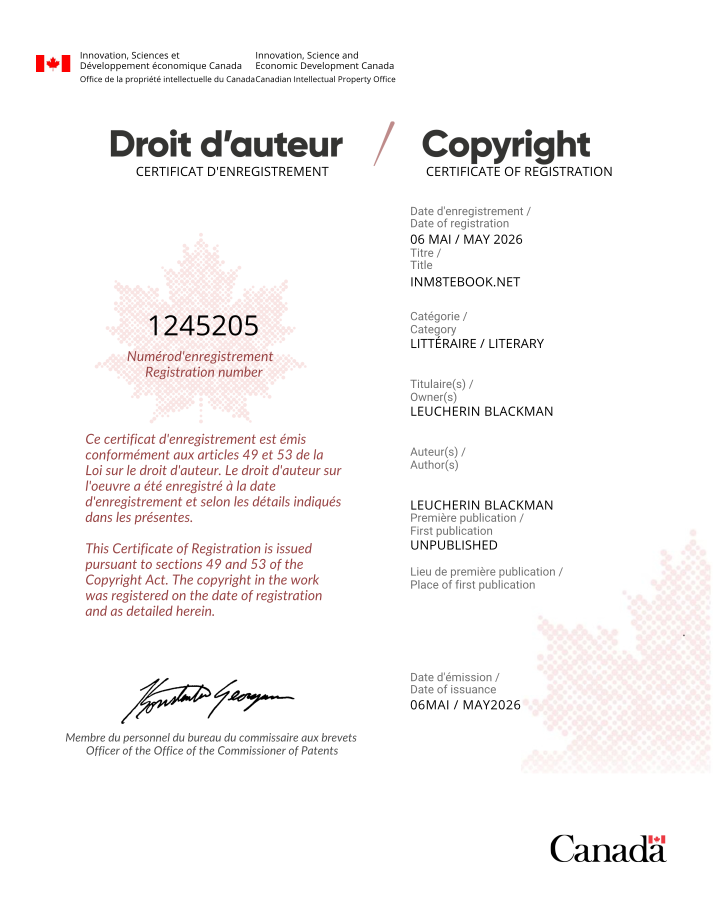
2. Is Copyright Registration Mandatory in Canada?
No. Copyright protection arises automatically under section 5 of the Copyright Act as soon as an original work is created and fixed in tangible form. However, registering with CIPO gives you:
- A Certificate of Registration that serves as evidence of ownership in court (s. 53)
- A public record that deters infringement and supports licensing deals
- A stronger position in infringement lawsuits — the burden shifts to the alleged infringer to prove they didn’t copy your work
- Recognition under international treaties (Berne Convention, UCC, TRIPS)
3. Who Can Register a Canadian Copyright?
Registration is open to:
- Canadian citizens and permanent residents
- Citizens of any country that’s a signatory to the Berne Convention, Universal Copyright Convention, or WTO (180+ countries)
- Corporations and other legal entities that own original works
- Estates of deceased creators
You do not need to live in Canada to register a Canadian copyright.
4. What Works Can Be Copyrighted in Canada?
The Copyright Act protects four main categories of works (s. 2):
Category | Examples |
Literary works | Books, articles, software code, compilations, tables |
Dramatic works | Films, scripts, screenplays, choreography, mimes |
Musical works | Compositions with or without lyrics, sheet music |
Artistic works | Paintings, drawings, photographs, sculptures, architectural works, maps |
Copyright also covers sound recordings, performer’s performances, and broadcast communication signals under separate ‘other subject matter’ provisions.
What cannot be copyrighted:
- Ideas, concepts, methods, or facts
- Names, titles, slogans, or short phrases (use trademark)
- Inventions or functional designs (use patent or industrial design)
- Works not yet fixed in tangible form
5. Copyright vs. Trademark vs. Patent
These three forms of intellectual property are often confused. Here’s how they differ in Canada:
Feature | Copyright | Trademark | Patent |
Protects | Original creative works | Brand identifiers | Inventions, processes |
Examples | Book, song, film, code | Brand name, logo | Machine, drug formula |
Governing law | Copyright Act | Trademarks Act | Patent Act |
Automatic? | Yes, on creation | No — must register | No — must apply |
Term | Life + 70 years | 10 yrs, renewable | 20 years from filing |
CIPO base fee (2026) | $63 online | ~$478 (1 class) | Variable |
Best for | Authors, artists, devs | Businesses, brands | Inventors, engineers |
6. How to Register Copyright in Canada: 6-Step Process
Step 1 — Confirm Your Work Qualifies
Verify that your work is original (not copied), fixed in tangible form, and falls into one of the protected categories above.
Step 2 — Gather the Required Information
You’ll need:
- Full title of the work
- Category (literary, dramatic, musical, artistic, or other subject matter)
- Author’s full legal name and citizenship
- Date and country of first publication (if published)
- Owner’s name and address (if different from author)
- Declaration of authorship and ownership
Important: CIPO does not require you to submit a copy of the work itself. You declare its existence; you don’t deposit it.
Step 3 — Complete the CIPO Application
File online through the CIPO Copyright e-Filing portal, or have an authorized agent like RegiCorp file on your behalf for faster, error-free submission.
Step 4 — Pay the Registration Fee
- $63 CAD for online filing
- $81 CAD for paper or fax filing (includes the $18 non-electronic surcharge)
- No taxes apply; fees are non-refundable once the application is received
Step 5 — CIPO Review
A CIPO examiner reviews your application for completeness and proper categorization. If something is missing or incorrect, they’ll issue a notice requesting correction.
Step 6 — Receive Your Certificate of Registration
Once approved, CIPO issues a Certificate of Registration — your prima facie evidence of copyright ownership under section 53 of the Copyright Act. Typical timeline: 4–8 weeks from filing.
Filing with RegiCorp: We prepare and submit your CIPO application within 1 business hour, with a copyright agent reviewing every detail before submission. File your copyright →
7. CIPO Copyright Fees in 2026
Service | Fee (CAD) |
Copyright application (online via CIPO portal) | $63 |
Copyright application (paper, fax, mail) | $81 |
Registration of an assignment or licence | $81 |
Certified copy of certificate | $35 |
Correction of a clerical error | $0 (free) |
Source: CIPO – Standard fees for copyright (ised-isde.canada.ca).
There are no maintenance or renewal fees — once registered, your copyright stays registered for its entire term.
8. How Long Does Canadian Copyright Registration Take?
CIPO typically issues a Certificate of Registration within 4–8 weeks of receiving a properly completed online application. Paper applications can take longer. Applications with errors or missing information may be delayed by months, which is the main reason creators use a copyright agent.
9. How Long Does Copyright Last in Canada?
For works created on or after December 30, 2022, Canadian copyright lasts for:
Life of the author + 70 years after the end of the calendar year of the author’s death.
This was extended from ‘life + 50 years’ by the Budget Implementation Act, 2022, No. 1 to align Canada with its CUSMA (USMCA) obligations.
Special terms apply to:
- Joint authorship: 70 years from the death of the last surviving author
- Anonymous/pseudonymous works: 75 years from publication, or 100 years from creation (whichever is earlier)
- Crown copyright: 50 years from publication
- Sound recordings: 70 years from publication (capped at 100 years from fixation)
After the term expires, the work enters the public domain.
10. Fair Dealing in Canada (Not 'Fair Use')
A critical distinction: Canada uses ‘fair dealing,’ not American ‘fair use.’ Fair dealing under sections 29–29.2 of the Copyright Act is narrower and limited to specific purposes:
- Research
- Private study
- Education
- Parody or satire
- Criticism or review (with attribution)
- News reporting (with attribution)
Courts assess fairness using six factors from CCH Canadian Ltd. v. Law Society of Upper Canada (2004 SCC 13): purpose, character, amount, alternatives, nature of the work, and effect on the market.
If your intended use doesn’t clearly fit one of these purposes, you should obtain a licence from the copyright owner.
11. Benefits of Registering Your Copyright
- Legal evidence — Your certificate is prima facie proof of ownership (s. 53).
- Public record — Anyone searching CIPO’s Copyright Database can see your registration.
- Stronger infringement claims — Burden shifts to the alleged infringer.
- Licensing & monetization — Registered copyrights are easier to sell, license, or use as collateral.
- Investor & buyer confidence — Registered IP increases the valuation of creative businesses.
- International recognition — Through the Berne Convention, your Canadian registration is recognized in 180+ member countries.
12. International Copyright Protection
Canada is a member of several major international treaties:
- Berne Convention for the Protection of Literary and Artistic Works
- Universal Copyright Convention (UCC)
- WIPO Copyright Treaty (WCT)
- Agreement on Trade-Related Aspects of Intellectual Property Rights (TRIPS)
- CUSMA / USMCA (Canada–United States–Mexico Agreement)
This means your Canadian copyright is automatically recognized in every member country, without further registration — though local registration may still offer procedural benefits in some jurisdictions.
13. What Counts as Copyright Infringement in Canada?
Infringement occurs when someone, without authorization, does anything that only the copyright owner has the right to do. Under the Copyright Act, this includes:
- Reproducing the work (in whole or substantial part)
- Publishing or distributing copies
- Performing the work in public
- Communicating the work to the public (including online)
- Creating derivative works (translations, adaptations)
Remedies available under sections 34–41 of the Copyright Act include:
- Injunctions to stop the infringement
- Damages (actual or statutory)
- Account of profits
- Delivery up of infringing copies
- Statutory damages of $500–$20,000 per work for commercial infringement, or $100–$5,000 total for non-commercial infringement
Frequently Asked Questions (Faq's)
Is copyright registration mandatory in Canada?
No. Copyright exists automatically the moment an original work is created and fixed in tangible form. Registration is optional but provides strong legal advantages.
How much does it cost to copyright something in Canada in 2026?
$63 CAD for online filing with CIPO, or $81 CAD for paper/fax filing. There are no renewal fees.
Can I copyright an idea?
No. Copyright protects only the expression of ideas in fixed, tangible form — not the ideas, concepts, methods, or facts themselves.
Can a non-Canadian register a Canadian copyright?
Yes. Citizens of any Berne Convention or WTO member country can register a copyright with CIPO.
How long does CIPO take to register a copyright?
Typically 4–8 weeks for online applications with no errors. Paper applications take longer.
Do I need to send a copy of my work to CIPO?
No. Canadian copyright registration is a declaration system — you describe the work; you don’t deposit it.
What's the difference between copyright and trademark?
Copyright protects original creative works (books, music, art, code). Trademarks protect brand identifiers (names, logos, slogans) used in commerce.
How long does copyright last in Canada?
For works created on or after December 30, 2022, copyright lasts for the life of the author plus 70 years after the end of the year of death.
What is fair dealing?
Canada’s equivalent of the U.S. ‘fair use.’ It allows limited use of copyrighted works without permission for research, private study, education, parody, satire, criticism, review, or news reporting — subject to a fairness test.
Ready to Register Your Copyright?
Protect your work today. RegiCorp’s copyright agents file your CIPO application within 1 business hour and review every detail to prevent costly rejections.
- Filed by experienced copyright agents
- All CIPO requirements verified
- Transparent flat-fee pricing
- Includes government fee
Reviewed by [Name], CIPO-Registered IP Filing Agent. [X] years of experience filing copyright, trademark, and patent applications with the Canadian Intellectual Property Office.
Last updated: [Insert publish/update date]
Disclaimer: This guide is for general information only and is not legal advice. For specific legal questions, consult a Canadian IP lawyer.